

The Personal Computer Is Having An Identity Crisis — And Nvidia Thinks It Has The Cure
Mumbai (Maharashtra) [India], June 4: For nearly two decades, the personal computer has been living through a quiet existential crisis.
Once upon a time, the PC was the undisputed monarch of the digital kingdom. It stored your files, ran your applications, processed your work, and occasionally crashed at the exact moment you forgot to save a document. It was frustrating, indispensable, and entirely its own machine.
Then the cloud arrived.
Gradually, the heavy lifting moved elsewhere. Storage migrated to remote servers. Software became subscriptions. Streaming replaced downloads. Even productivity began depending on distant data centers humming away in anonymous warehouses thousands of miles from the user.
The modern laptop became less of a powerhouse and more of a portal.
Now, NVIDIA appears determined to reverse that trend.
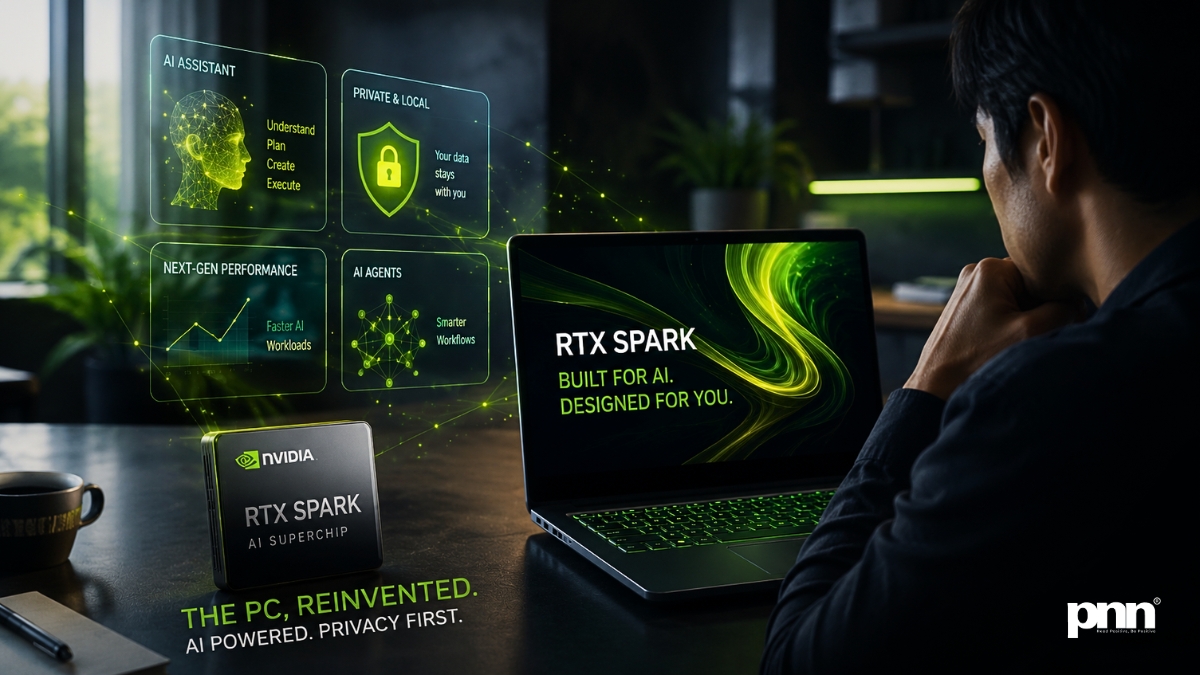
The semiconductor giant recently unveiled its RTX Spark AI superchip, a platform designed to bring advanced artificial intelligence capabilities directly onto laptops and desktop computers. Major manufacturers, including Dell, Lenovo, Asus, and HP, are expected to integrate the technology into upcoming systems, signaling what could become one of the most significant shifts in personal computing since the rise of cloud services.
On the surface, it sounds like another hardware announcement. The technology industry produces enough of those to fill several lifetimes. Beneath the marketing language, however, lies a far more intriguing development.
NVIDIA is not simply introducing a faster chip.
It is attempting to redefine what a personal computer actually is.
And if successful, the implications could stretch far beyond gaming, productivity, or hardware sales.
The Return Of Local Computing
For years, artificial intelligence has largely belonged to whoever owned the biggest data center.
Need an AI assistant? Connect to the cloud.
Need image generation? Connect to the cloud.
Need advanced reasoning? Connect to the cloud.
The arrangement worked well enough, provided users were comfortable handing their data, workflows, and digital habits to remote infrastructure operated by some of the world’s largest technology companies.
Convenience won the argument.
At least until AI models became powerful enough to raise uncomfortable questions about privacy, latency, cost, and dependence.
Running AI in distant data centers requires enormous computational resources. Those resources cost money. They consume electricity. They create delays. They also place a remarkable amount of power into the hands of a relatively small number of corporations.
NVIDIA’s RTX Spark initiative suggests the industry may be exploring another path.
Instead of sending every request to a remote server, future computers could perform many AI tasks locally. AI assistants, workflow automation systems, creative applications, and even sophisticated reasoning models could operate directly on the device sitting in front of the user.
In other words, the computer may once again become the place where the work actually happens.
A surprisingly radical concept in 2026.
The Age Of The Personal AI Employee
The most interesting aspect of Nvidia’s strategy is not performance. It is autonomy.
The technology sector is rapidly moving beyond chatbots toward agentic AI systems capable of performing tasks rather than simply answering questions. These systems can schedule appointments, organize information, manage workflows, conduct research, and potentially execute complex chains of actions with minimal supervision.
Every major technology company is chasing this vision.
The challenge is that such systems require substantial computational power.
Cloud-based AI agents remain effective, but they introduce costs and dependencies that businesses increasingly want to reduce. Local AI processing offers an alternative. If advanced AI can run efficiently on laptops and workstations, organizations gain greater control over their data while reducing reliance on constant cloud connectivity.
This is where RTX Spark becomes strategically important.
Rather than positioning AI as an external service, Nvidia is positioning it as a permanent resident inside the machine.
The distinction may seem subtle.
It is not.
One approach rents intelligence. The other owns it.
Why Nvidia Suddenly Wants More Than Gamers
Historically, Nvidia built its empire through graphics processing.
Gaming fueled growth. Visual computing created demand. Data centers later transformed the company into one of the world’s most valuable technology firms.
Artificial intelligence changed everything.
Today, Nvidia sits at the center of the global AI boom. The company’s GPUs have become essential infrastructure for training and running advanced models. Its market valuation has soared into the trillions, driven largely by demand from AI companies, cloud providers, and enterprise customers.
Yet success creates new challenges.
As AI adoption expands, Nvidia cannot rely exclusively on data centers. The company needs growth across consumer devices, enterprise workstations, edge computing systems, and next-generation PCs.
RTX Spark represents an attempt to extend Nvidia’s dominance beyond server farms and into everyday computing.
The strategy is logical.
If AI becomes embedded into every device, Nvidia wants to supply the engine powering that transformation.
The company is essentially betting that future PCs will be judged less by processing speed and more by their ability to host intelligent software.
The Benefits Are Real
There are compelling reasons why local AI processing has attracted so much attention.
First, privacy improves. Sensitive information can remain on the device rather than traveling through multiple cloud systems.
Second, performance becomes more immediate. Tasks can be executed without waiting for remote servers to process requests.
Third, businesses gain more control over proprietary information, reducing concerns surrounding data exposure.
Potential advantages include:
- Faster AI-assisted workflows.
- Reduced cloud dependency.
- Better privacy protections.
- Lower long-term operational costs.
- Improved offline functionality.
For enterprise customers especially, these benefits are becoming increasingly attractive as AI adoption accelerates.
The Catch Nobody Likes To Discuss
Of course, every technological revolution arrives carrying a suitcase full of complications.
Advanced AI hardware is expensive.
The chips required to run sophisticated models locally are not cheap to manufacture, particularly as semiconductor supply chains remain under pressure. Consumers already face rising costs for premium devices, and integrating increasingly powerful AI hardware could push prices even higher.
There is also the question of necessity.
Many users already struggle to justify annual smartphone upgrades. Convincing consumers they need an AI-first laptop may prove considerably more difficult.
History offers numerous examples of impressive technology searching desperately for a practical use case.
Not every innovation becomes indispensable.
Sometimes it merely becomes expensive.
Another concern involves energy consumption. Running advanced AI locally requires significant processing power, which inevitably impacts battery life, thermal management, and device design.
Building smarter machines is one challenge.
Building smarter machines that remain portable is another.
The Bigger Battle Is Just Beginning
RTX Spark arrives during a period of extraordinary competition.
Microsoft is integrating AI throughout Windows. Apple continues expanding its AI ecosystem. Google is embedding AI across productivity tools and consumer services. Meanwhile, semiconductor manufacturers worldwide are racing to develop specialized hardware for machine learning applications.
This competition is transforming the PC industry from a mature market into a battleground once again.
Ironically, artificial intelligence may be accomplishing what years of incremental upgrades could not.
It is making personal computers interesting again.
Whether consumers embrace the vision remains uncertain. What is clear is that the definition of a PC is changing. Future computers may no longer be passive tools waiting for instructions. They may become active participants in workflows, capable of assisting, organizing, creating, and executing tasks independently.
That possibility explains why Nvidia’s latest announcement matters.
This is not merely about a chip.
It is about an attempt to move intelligence out of distant data centers and place it directly into the machine sitting on your desk.
For years, the technology industry told us the future lived in the cloud.
NVIDIA is quietly suggesting the future may be coming back home.
