

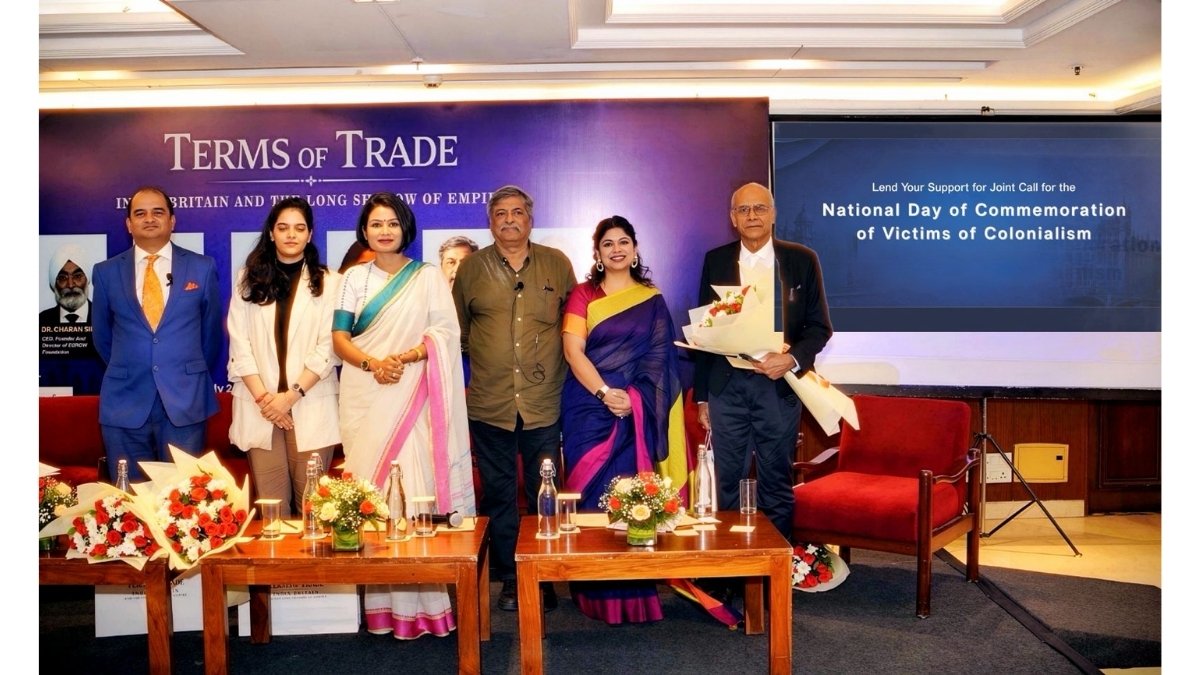
L To R – PK Basu, Chandini Jaswal, Moderator, Prof Prabhu Mohapatra, Divya Bhatia and Colin Gonsalves
New Delhi [India], July 18: India’s evolving relationship with the United Kingdom should be understood not only through the lens of trade and diplomacy, but through a deeper reckoning with the countries’ shared colonial history and its lasting legacy. That was the central thread running through Terms of Trade: India, Britain, and the Long Shadow of Empire, a public dialogue convened by Urzu Media at the India Habitat Centre in New Delhi — a conversation that culminated in a call to establish a National Day of Commemoration for Victims of Colonialism.
Closing the dialogue, all the experts and dignitaries announced its intention to begin wider consultations, with historians, academics, civil society organisations, museums, public institutions and policymakers, to establish a National Day of Commemoration for Victims of Colonialism, with the specific date to be finalised through this same consultative process.
The event closed with an interactive discussion involving policymakers, academics, students, media professionals and members of civil society in the audience.
While CETA provided the immediate context for the conversation, speakers agreed that understanding the historical relationship between the two countries is equally essential to building a mature, informed and equitable partnership going forward.
The panel featured Dr. Charan Singh (CEO & Founder Director, EGROW Foundation), Prof. Abhijit Das (International Trade Policy & WTO Expert), Prasenjit K. Basu (Economist & Historian, author of Asia Reborn and India Reborn), Prof. Prabhu Mohapatra (Retd. Professor & Head, Department of History, Delhi University), Colin Gonsalves (Senior Advocate, Supreme Court of India; Founder, Human Rights Law Network), and Chandini Jaswal (Communications Team Member, The Museum of British Colonialism, UK–Kenya), moderated by Richa Jain Kallra.
The event also featured a special presentation by Vijay Kumar Sundaresan, Co-Founder of the India Pride Project, who spoke about the organisation’s work tracing and repatriating India’s stolen artefacts, and the broader cultural and historical impact of that effort.
Across the discussion, speakers examined colonialism through multiple lenses, economic extraction, labour and migration history, legal and constitutional legacy, public history and museums, and collective memory.
The discussion brought together economists, historians, trade-policy experts, and a leading human rights lawyer to examine how nearly two centuries of colonial rule shaped India’s economy, institutions, industries, legal systems and public memory, and how that history continues to inform the country’s contemporary policy choices.
A recurring theme was that colonial rule was not merely a political episode, but a transformative force that reshaped India’s economic trajectory, governance structures, industries and social fabric. Several speakers reflected on how a clearer historical understanding can inform better policymaking, stronger public institutions, and a fuller public appreciation of India’s journey since Independence.
What speakers said?
Das while addressing the audience said, “Today, the focus of a trade deal extends beyond physical resources to data, the “new oil” of the digital age.” He cautioned that India is a huge source of data and unrestricted access to Indian data under such agreements could have serious long-term implications for India’s economic sovereignty and strategic interests. “We would like India data to be used for creating national digital champions, which can only be done if Indian data is exclusively shared with Indian players,” he added.
Singh was also critical about the recently trade agreement between the two nations. He said nothing has changed since Britishers landed in 1600s as traders, today they are again coming in India as traders. “The per capita income of Britain today is around US$ 15,000, while per capita income of an Indian today is US$ 2,880. When East India Company came to India we were accounting for 25 per cent of world GDP, when they left us we were at that point of time 1 per cent of global GDP. Today we are 4 per cent of global GDP. So, it does not provide a level playing field. The agreement would allow the UK to dictate the terms of trade, leaving India with little choice but to accept conditions that primarily serve British interests.”
Gonsalves criticized the government’s handling of the proposed trade agreement, alleging a lack of transparency in the negotiation process. He said the government had not made the text of the treaty public, arguing that such agreements should be debated and ratified by Parliament, as citizens have a right to know the commitments being made on their behalf. He noted that, in his view, the British government places trade treaties before Parliament for discussion, describing this as an established democratic practice.
However, Basu supported the India–UK Free Trade Agreement, describing it as a beneficial arrangement for both countries. He argued that the pact would boost India’s exports and create new economic opportunities.
Chandni highlighted that the United Kingdom proposed Carbon Border Adjustment Mechanism (CBAM) should not be part of the India-UK Free Trade Agreement as it could have affect on certain Indian exports and also developing countries like India have a limited impact on global climate change
One point several speakers returned to was the fragmented state of India’s colonial memory. India already commemorates significant episodes tied to colonial rule, among them Jallianwala Bagh, the famines, the freedom movement and Partition, but these are typically remembered as separate events rather than as connected chapters of one history.
The discussion explored what role universities, museums, archives, civil society and the media could play in helping future generations engage with this history through research, evidence and open public dialogue, rather than through commemoration alone.
The proposed day is envisioned as an inclusive platform for remembrance, one that recognises India’s colonial experience as a set of interconnected histories, spanning economic exploitation, famine, displacement, cultural loss, and the long arc of resistance and freedom struggles, rather than a single, isolated event.
The proposal has already begun generating interest beyond the roundtable itself, with early conversations underway across institutions and civil society groups engaged with India’s colonial history. Urzu Media said it hopes historians, institutions, civil society organisations and members of the public will continue to lend their support to the cause as the proposal moves forward.
The event closed with an interactive discussion involving policymakers, academics, students, media professionals and members of civil society in the audience.
If you object to the content of this press release, please notify us at pr.error.rectification@gmail.com. We will respond and rectify the situation within 24 hours.
