

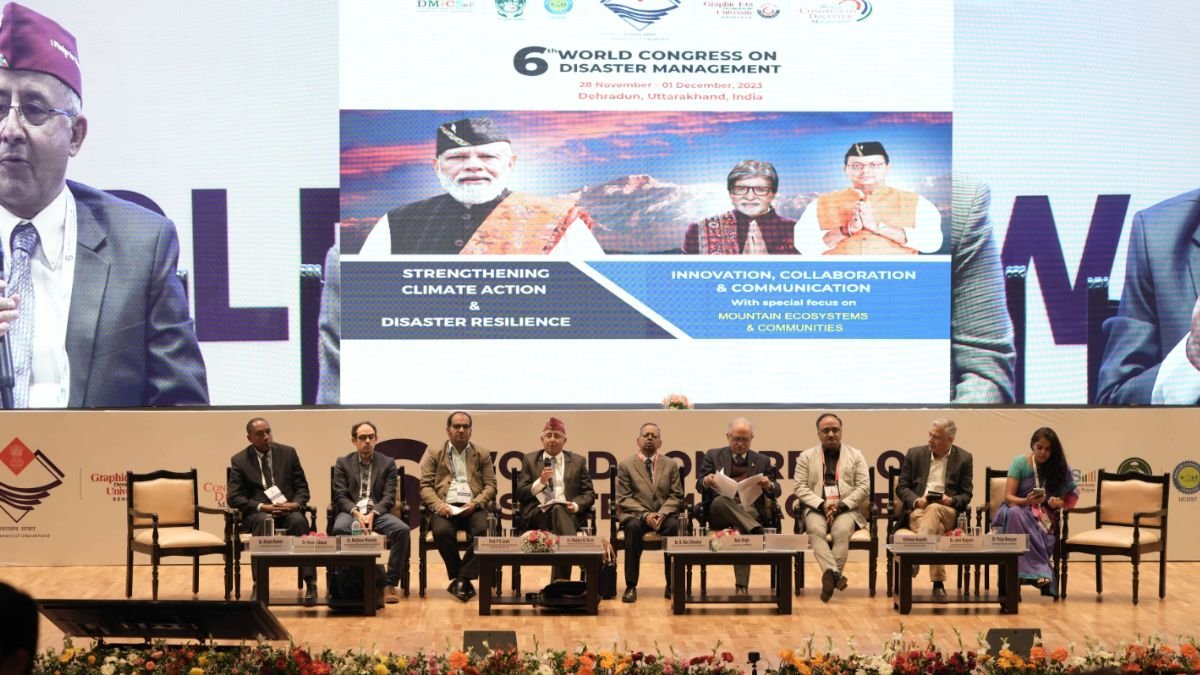
New Delhi (India), November 30: In the first session of the day, discussions focused on Eco-Disaster and Risk Reduction. The second session delved into “National and Global Public Health Emergency and Disaster Response,” exploring how emergency health services can be mobilized during disasters. Technical sessions at the international conference covered topics such as Space-based Information for Disaster Management, Building Resilience of Communities through Ecosystem-based Approaches, Marine Disaster Management, Inland Water Resources Impact on Environment-Building, and Economic Foxes.
Dr. Madhav B. Karki, former advisor to the Prime Minister of Nepal and member of IPEPCISEMEN Nepal, chaired the first session. In his address, he expressed concerns about rising temperatures and emphasized solving future disasters through Eco-Disaster and Risk Reduction strategies.
Dr. N. Ravishankar, former Chief Secretary of Uttarakhand and Chancellor of DIT University Dehradun, who presided over the panel discussion, highlighted the need for coordination between humans and machines and shed light on mutual needs and innovations.
The main speaker for the first session, Mr. Ravi Singh, Secretary-General and CEO of WWF India, emphasized the distinct nature of disaster situations in mountain and coastal regions. He discussed how the entire ecosystem undergoes changes during disasters, affecting human and animal life, as well as aquatic organisms.
Mr. Singh called for global collaboration among environmental organizations to collectively work towards sustainable development. He stressed the importance of knowledge and capacity building, stating that people need sufficient information about disaster and environmental issues to make informed decisions and take effective actions during emergencies.
The program featured other panelists such as Dr. Matthew Westoby, Associate Professor of Physical Geography at the School of Geography, Earth, and Environmental Sciences, University of Plymouth, UK. In his address, he emphasized the interconnectedness of life and nature in high-altitude and mountain regions, urging for a balance to sustain the entire ecosystem amidst changes, citing the Kedarnath tragedy and alterations in rivers originating from the Himalayan region. Dr. Westoby also discussed the impact of hydro-power projects on ecosystems, highlighting both their creation and degradation aspects.
Dr. Priya Narayan, Senior Manager of Urban Development at WRI India, spoke about the impact of climate change on India, emphasizing that environmental changes are no longer limited to specific states but are evident throughout the country. She discussed the “Kaavaki Pahal” initiative in Kerala, aiming to maintain harmony between mountains, plains, and coastal areas.
Dr. Haman Unusa, Unit Head for Studies and Projection at GEF Operational Focal Point, Cameroon, highlighted the agricultural impact of climate change and disasters. He suggested planting bamboo along riverbanks to control soil erosion, benefiting both the environment and the economy through various bamboo products.
Mr. Kritiman Avasthi, Senior Advisor and Team Leader at Wetland Management Biodiversity and Climate Protection, Indo-German Biodiversity Program, GIZ India, emphasized the need for capacity building and training at the grassroots level, especially in Panchayats, to reduce disaster risks effectively.
Dr. Harish Bahuguna, Deputy Director General of Geological Survey of India, discussed landslides and their widespread impact on ecosystems, emphasizing that the true extent of damage becomes apparent only after ecosystem changes. Dr. Shalini Dhyani highlighted the rapid impact of climate change on mountainous regions, causing the decline of various species after studying ecosystems and biodiversity.
The second session focused on national and global public health emergencies and disaster response. Panelists included Vinod Chandra Menon, Founder Member of the National Disaster Management Authority, Government of India; Professor Hemchand, Chancellor of HNB Uttarakhand Medical Education University; Major General Professor Atul Kotwal, SM, VSM; Dr. Chris Brown, Director of the Division of Emergency Operations, Office of Readiness and Response, US CDC; and Dr. Saurabh Goyal, Joint Director IDSP, NCDC, MOHFW.
Technical sessions covered space-based information for disaster management, building community resilience through an ecosystem-based approach, and the impact of marine disaster management on inland water resources and the economy.
In an interview, Professor P.K. Joshi, School of Environmental Sciences, Special Centre for Disaster Research, Jawaharlal Nehru University, New Delhi, emphasized the significance of understanding global issues discussed at this international event, shedding light on the seriousness with which these challenges are being addressed.
If you have any objection to this press release content, kindly contact pr.error.rectification@gmail.com to notify us. We will respond and rectify the situation in the next 24 hours.
