

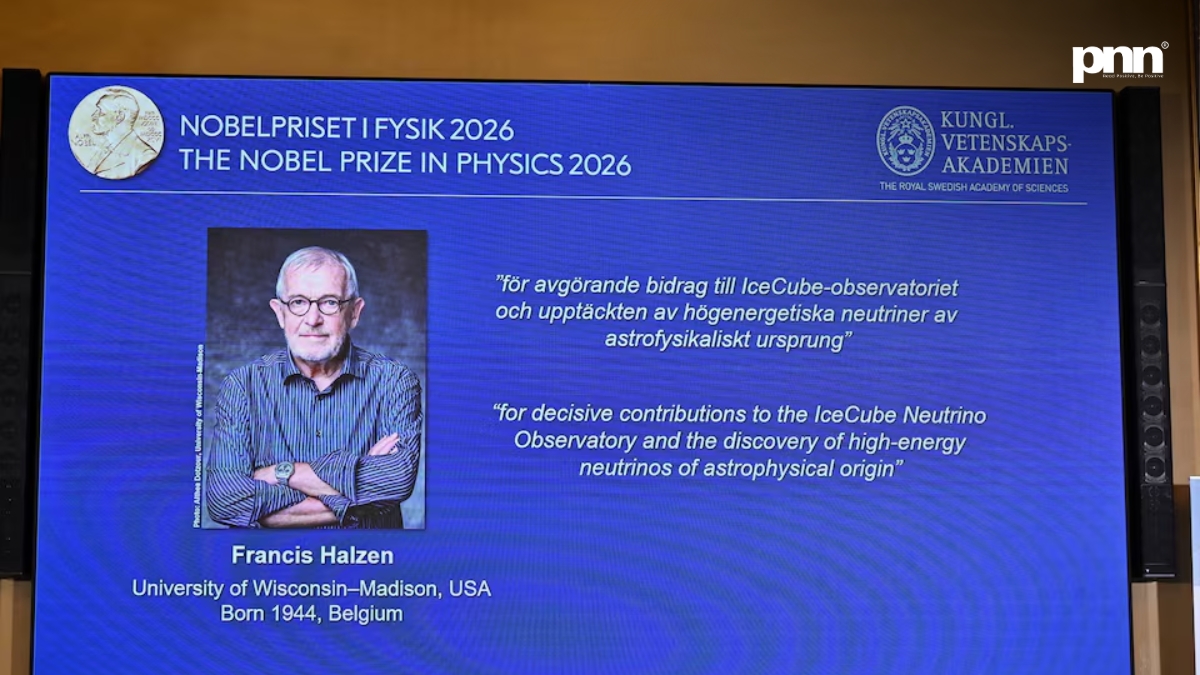
New Delhi [India], October 6: Francis Halzen has won the 2026 Nobel Prize in Physics for helping turn Antarctic ice into an observatory capable of detecting some of the universe’s most elusive particles. Announced on October 6, the award recognises his decisive contributions to the IceCube Neutrino Observatory and the discovery of high-energy neutrinos arriving from space.
For the Belgian-born physicist at the University of Wisconsin–Madison, the honour crowns a project built around an extraordinary idea: that looking deep beneath the South Pole could help scientists understand what happens far beyond Earth. The prize carries an award of 12 million Swedish kronor.
Neutrinos are often called “ghost particles” because they rarely interact with matter. They have no electrical charge and very little mass, allowing vast numbers to pass through planets and people unnoticed. Scientists have known about them for decades, but detecting the exceptionally energetic neutrinos produced in distant cosmic environments presented a formidable challenge.
Their elusive nature also makes them valuable. Charged particles can be deflected by magnetic fields during their journey through space, obscuring where they came from. Neutrinos travel almost undisturbed, carrying clues about the powerful processes that produced them. Detecting their arrival directions gives astronomers a way to investigate cosmic accelerators that remain difficult to understand.
Halzen presented his vision for detecting neutrinos at the South Pole in 1988. The clear Antarctic ice offered a vast natural medium in which the faint signals from rare particle interactions could be recorded. Turning that possibility into a working observatory required years of research and international collaboration.
IceCube’s original array contains 5,160 optical sensors embedded in roughly a cubic kilometre of ice. Constructing it meant drilling deep holes with hot water, lowering instruments into them and allowing the water to freeze again. The final string of sensors was deployed in December 2010, following seven Antarctic construction seasons.
The observatory detects neutrinos indirectly. When one interacts with matter in or near the detector, it can produce charged particles that emit a faint blue glow known as Cherenkov light. Sensors record the light’s timing and brightness, allowing researchers to estimate the incoming neutrino’s energy and direction. A brief flash beneath the ice can therefore become evidence of activity across the universe.
A major breakthrough came in 2013, when the IceCube collaboration reported evidence of high-energy neutrinos originating beyond the solar system. The finding established that the detector could identify the cosmic particles it had been designed to seek, giving astronomers a new way to study the energetic universe.
The next challenge was identifying their sources. In September 2017, IceCube detected a high-energy neutrino and alerted astronomers worldwide. Follow-up observations helped link the event to TXS 0506+056, a distant blazar—a galaxy with a supermassive black hole powering a jet directed towards Earth. Results published in 2018 provided evidence connecting such an object with high-energy neutrino production.
Further progress followed in 2023, when researchers produced the first neutrino-based image of the Milky Way. Using these particles, they detected high-energy emission from our galaxy, adding another layer to the picture built by conventional telescopes. The result also depended on separating the faint galactic signal from particles generated in Earth’s atmosphere.
Mark Pearce, chair of the Nobel Committee for Physics, said Halzen’s persistence and scientific vision had “paved the way for a new kind of astronomy”.
The search remains unfinished. Researchers still need more observations to identify neutrino sources precisely and understand how they accelerate particles to such extreme energies. IceCube’s proposed next-generation expansion aims to increase that reach. Halzen’s Nobel recognises a discovery that has already changed astronomy, while the detector beneath Antarctica continues gathering evidence for the questions that follow.
