

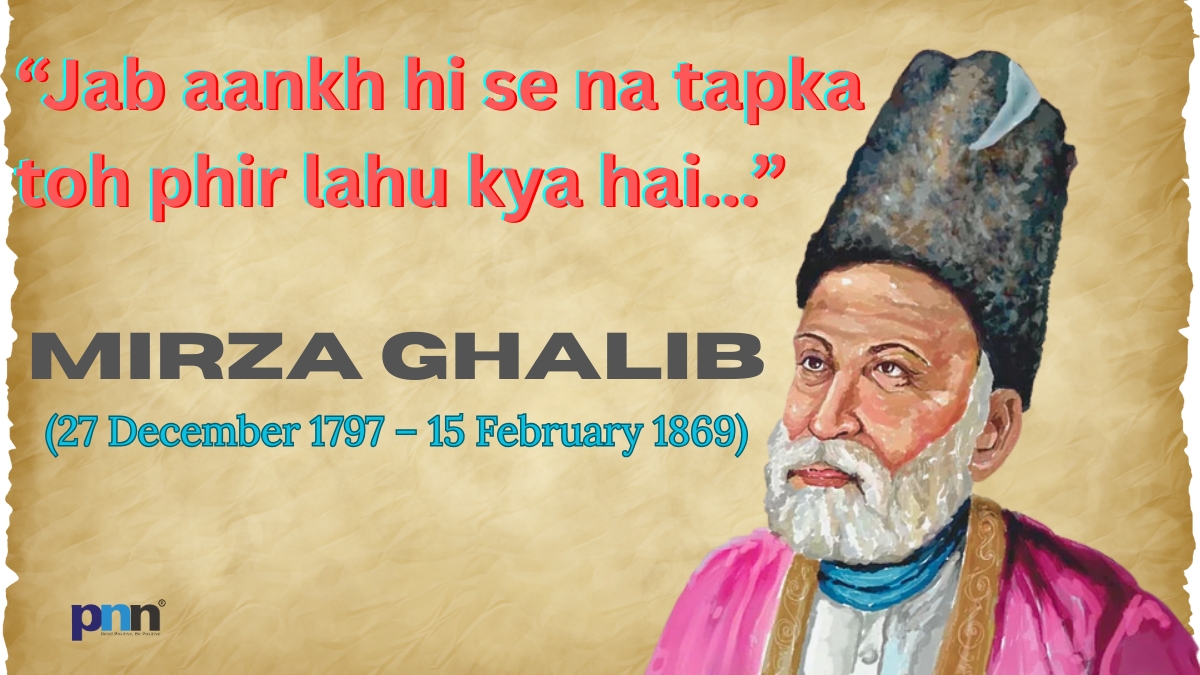
New Delhi [India], January 24: Mirza Ghalib is treated like a relic. Framed. Sanitised. Quoted on calendars and WhatsApp forwards as if he were some polite uncle who happened to rhyme well. That version is convenient. It’s also false.
The real Ghalib was argumentative, broke, vain, deeply insecure, intellectually arrogant, emotionally reckless, and almost permanently irritated with the world around him. Which is precisely why he still matters. Especially now. Especially here.
India has a strange habit of embalming its thinkers. Once they’re dead long enough, we bleach out the mess and keep the aesthetics. With Ghalib, we kept the couplets and discarded the temperament. Big mistake. His poetry wasn’t decorative. It was confrontational. It asked questions nobody around him wanted to answer, least of all himself.
He once wrote, almost casually:
“Hazāron ḳhvāhisheñ aisī ki har ḳhvāhish pe dam nikle.”
Thousands of desires, each one enough to take my breath away.
That’s not romance. That’s exhaustion dressed up as confession.
Ghalib didn’t write about love the way Bollywood insists love should look. He wrote about its after-effects. The damage. The echo that stays long after the person is gone. Ishq, for him, was not a solution or a destiny. It was a condition. Chronic. Untreatable. Something you learned to articulate so it didn’t eat you alive.
“Ishq ne ‘Ghalib’ nikamma kar diya,
Warna hum bhi aadmi the kaam ke.”
Love ruined Ghalib, made him useless.
Otherwise, I too was a man of some use.
Self-awareness with a bite. No self-pity ribboned around it.
That alone should make him uncomfortable reading in a country obsessed with closure, with moral endings, with neat conclusions. Ghalib refused all of that. He distrusted certainty. Especially religious certainty. Especially social certainty. He questioned God with the same casual sharpness others reserved for lazy clerks or dishonest friends. And he did it in a language so elegant people missed how radical it was.
“Hum ko maaloom hai jannat ki haqeeqat lekin,
Dil ke khush rakhne ko ‘Ghalib’ ye khayal achha hai.”
I know the truth of paradise, but still—
To keep the heart content, this illusion is nice.
That line alone would start fights today. It still should.
Which brings us to the uncomfortable bit. Ghalib wasn’t a nationalist poet. He wasn’t interested in flags or slogans or collective pride. He lived through the collapse of Delhi, the violence of 1857, the slow erasure of a culture, and he responded not with patriotic verse but with private reckoning. Loss as lived experience, not performance. That refusal to turn suffering into spectacle is maybe his most modern trait.
We don’t talk about that enough. We prefer him as a romantic mascot. Less dangerous that way.
There’s also the small issue of his elitism. Ghalib knew he was smarter than most people in the room and didn’t bother pretending otherwise. He mocked mediocrity. He resented ignorance. He wrote letters that dripped with sarcasm and impatience. Today, that would make him deeply unpopular on social media. Too sharp. Too unwilling to soften his edges for applause.
“Bas-ki dushvaar hai har kaam ka aasaan hona,
Aadmi ko bhi mayassar nahin insaan hona.”
Everything difficult insists on pretending to be easy;
Even being human isn’t easily granted to a man.
That’s not poetic gloom. That’s social diagnosis.
But that’s exactly why his voice cuts through even now. Read him carefully and you realise he wasn’t trying to be profound. He was trying to be precise. Precision, especially emotional precision, is rare in public discourse today. We prefer volume. He preferred accuracy. Sometimes cruel accuracy.
His relationship with faith is a case in point. Ghalib believed in God, probably. Then doubted it. Then argued with it. Then mocked the entire process. He treated belief as a living argument, not a fixed position. In an era where belief has hardened into identity and identity into weaponry, that kind of intellectual restlessness feels almost subversive.
“Pakarte ho jo mujhe qaid mein, sach yeh hai ‘Ghalib’,
Tum apne daaman-e-fikr ko zara phaila ke dekho.”
If you think you’ve captured me in confinement,
Try expanding the limits of your own thought first.
Even now, that sounds like a warning.
And look, he wasn’t always likable. He could be petty. He could be indulgent. He could spiral. There are moments in his work where self-pity borders on narcissism. But that’s the price of honesty. He didn’t clean himself up for posterity. He wrote from inside the mess. The unpaid debts. The failed patronage. The sense of being overlooked in a world that rewarded safer talent.
This always gets lost when we teach him as curriculum instead of conflict.
An editorial about Ghalib, then, isn’t about praising his genius. That’s settled. It’s about acknowledging how inconvenient he still is. How little he fits into our current appetite for moral clarity and ideological obedience. He doesn’t reassure. He destabilises. Quietly. With impeccable grammar and a raised eyebrow.
“Ragon mein daudte phirne ke hum nahin qaayal,
Jab aankh hi se na tapka toh phir lahu kya hai.”
I don’t believe in blood merely rushing through veins;
If it doesn’t spill from the eyes, what blood is that?
Tell me that isn’t emotional extremism, sharpened into art.
He also understood something we keep forgetting: that language is not meant to comfort power. It’s meant to interrogate experience. His Urdu wasn’t ornamental. It was surgical. Every word chosen not to impress but to survive the thought it carried.
India doesn’t lack poets. It lacks readers willing to sit with discomfort. Ghalib demands that. He demands slowness. Re-reading. Sitting with a couplet until it stops sounding beautiful and starts sounding true. That’s hard work. Easier to quote him at mushairas and move on.
So yes, celebrate him. But don’t tame him. Don’t turn him into a cultural trophy. Let him remain difficult. Let him argue with your assumptions. Let him ruin your certainty a little.
That’s what he was always best at.
And frankly, that’s what this moment needs.
