

Kagan–Soai duo recognised for non-linear effects and homochirality research
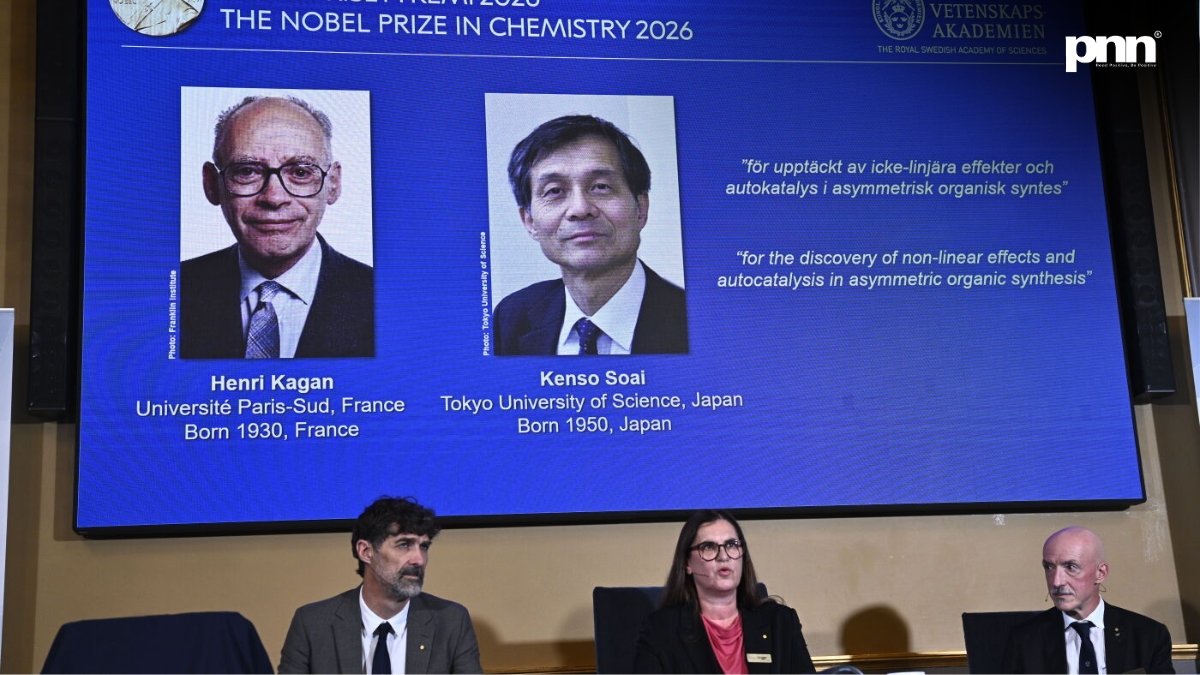
New Delhi [India], October 7: The 2026 Nobel Prize in Chemistry went to Henri B. Kagan from France and Kenso Soai from Japan, honoring their discoveries about non-linear effects and autocatalysis in asymmetric organic synthesis. The Royal Swedish Academy of Sciences made the announcement on Wednesday, recognizing their work for finally explaining how nature picks just one “handed” form among many molecules—a question that stumped researchers for more than a century.
Here’s why this matters: When it comes to life’s chemistry, shape really is everything. Many molecules inside us, like amino acids and sugars, exist in left- and right-handed versions, called enantiomers. It’s a bit like how your left and right hands look similar but don’t fit on top of each other. For reasons no one understood, life is incredibly picky—proteins use almost only left-handed amino acids, and DNA builds itself with right-handed sugars. Scientists call this “homochirality,” and it’s critical for all of life’s biochemistry. But where did this molecular bias come from?
That’s where Kagan and Soai step in. Their experiments showed that chemical reactions can take a tiny start—just a slight excess of one hand over the other—and blow it up into a nearly pure, single-handed result. Suddenly, there’s a real chemical pathway from a mixed bag of molecules to the one-sided chemistry that life depends on.
Kagan’s key moment came in 1986. Working at Université Paris-Sud, he realized that in some catalytic reactions, the outcome didn’t follow a straight line: if you started with a barely skewed catalyst, you could end up with far more of one “hand” of product than anyone expected. This “non-linear effect” overturned what chemists thought they knew. Now, they had a powerful trick to steer reactions toward making just one enantiomer.
Soai picked up the thread at Tokyo University of Science. He focused on autocatalysis—reactions where the product helps drive the reaction itself. By 1995, he designed a new chemical system that could, all on its own, become homochiral through this self-amplifying process. By 2003, he managed to show a reaction that churned out just one mirror-image form, no pure starting material needed. Before Soai, only life itself had ever pulled off this kind of complete symmetry break in the lab. He showed that even the tiniest imbalance—maybe just a random fluctuation—can snowball through autocatalysis, pushing chemistry toward perfect one-sidedness.
These breakthroughs matter far beyond the lab. In the world of pharmaceuticals, many drugs are chiral, and often only the “right” enantiomer works as a medicine—the other can do nothing or even cause harm. Kagan and Soai’s work helps chemists make safer and purer drugs, with less waste. And for anyone curious about how life started, their discoveries provide a convincing way for homochirality to show up naturally, making the case stronger that life on Earth—and maybe elsewhere—came about through real chemical processes, not pure chance.
Henri B. Kagan was recognized for finding non-linear effects in asymmetric catalysis, which let chemists massively amplify the amount of one mirror-image product. Kenso Soai was recognized for developing asymmetric autocatalysis and achieving the first fully homochiral chemical reaction. They share the Nobel Prize equally, their discoveries fitting together to change both how chemistry is done and how we understand biology’s deepest rules.
This Chemistry Nobel follows this year’s prizes in Physiology or Medicine and Physics, keeping the spotlight on discoveries that shape both science and society. With this award, the Swedish Academy is saying: if you want to understand life—or build it—you’d better pay attention to the way molecules pick a side.
