

By Ananya Mehra, Feature Correspondent (Enterprise Technology)
New Delhi [India], November 17: As the plain text message gives way to branded, verified, two-way channels, India has become the world’s busiest laboratory for programmable communication. Dr. Gulpreet Singh Arora, who built SMSGatewayHub into one of the country’s high-volume messaging platforms, on why the next decade of business communication will be conversational.
For most people, the first brush with a cloud communications platform is invisible. The one-time password that lands the instant you tap “pay”. The courier update that arrives on WhatsApp with a live map. The flight gate change that reaches you before the airport screens catch up. None of it feels like technology. That, says Dr. Gulpreet Singh Arora, is exactly the point.
“The best communication infrastructure is the kind nobody notices,” he says. “A customer should never think about whether a message travelled over SMS, RCS or WhatsApp. They should just feel that the business reached them at the right moment, on the channel they already live on.” It is a deceptively simple ambition, and it sits at the centre of one of the fastest-moving corners of enterprise software: CPaaS.
Key points
• CPaaS communications platform as a service is a set of cloud APIs that let any app send SMS, WhatsApp, RCS, email, voice and OTP verification without owning telecom infrastructure.
• India’s shift is driven by three forces at once: WhatsApp’s near-universal reach, the carrier rollout of RCS, and the DLT compliance regime that cleaned up commercial SMS.
• SMSGatewayHub’s bet is a single API with automatic channel fallback one instruction to “reach this customer”, and the platform chooses the channel that will actually land.
• RCS is the sleeper story: verified, branded, interactive messages that behave like a mini-app inside the default inbox.
• The frontier is conversational AI and passwordless verification not louder one-way alerts, but genuine two-way dialogue.
What exactly is CPaaS and why is everyone suddenly talking about it?
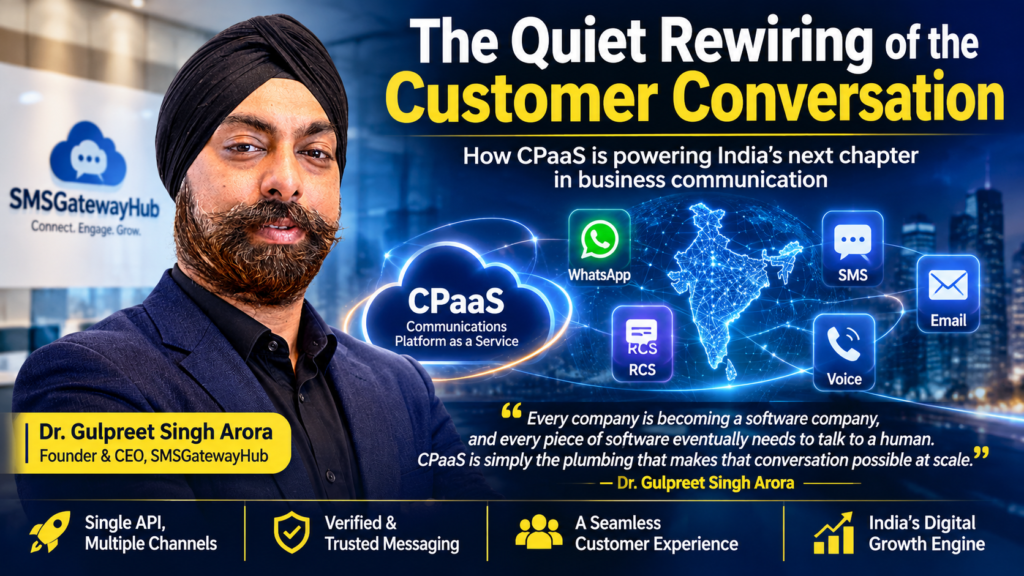
CPaaS, short for communications platform as a service, is a layer of cloud APIs that lets software send and receive messages across many channels SMS, WhatsApp, RCS, email, voice calls and one-time-password verification without a company having to build or run its own telecom connections. In practice, a developer writes a few lines of code, and the platform handles the carrier links, the routing, the compliance and the delivery receipts behind it.
The category has existed for years, but it moved from a convenience to a necessity as every business turned into a software business. “A decade ago, messaging was a feature you bolted on,” Arora says. “Today the conversation is the product. Your delivery experience, your support, your onboarding, your payments all of it happens in a thread. If that thread breaks, the business breaks.”
“Every company is becoming a software company, and every piece of software eventually needs to talk to a human. CPaaS is simply the plumbing that makes that conversation possible at scale.”Dr. Gulpreet Singh Arora
Why has India become a proving ground?
Three forces have converged in India at the same time: the near-universal reach of WhatsApp, the carrier-led rollout of RCS as a successor to SMS, and the DLT framework that forced commercial messaging onto a verified, consent-based footing. Few other markets have all three pressures at once, which is why global platforms now watch Indian messaging patterns closely.
WhatsApp gave India a messaging habit at a scale matched almost nowhere else. The DLT regime the regulator’s distributed-ledger registration of senders and templates did something subtler: it made commercial SMS trustworthy again by tying every message to a registered entity and an approved template. “People criticised DLT when it arrived,” Arora recalls. “But it quietly solved the spam problem that was killing SMS. It turned a noisy channel into an accountable one. That accountability is now the foundation everything else is built on.”
From an SMS gateway to an omnichannel platform
SMSGatewayHub began, as its name suggests, moving text messages and then followed its customers as they spread across channels, adding WhatsApp Business, RCS, email and voice under a single programmable interface. The guiding idea, Arora says, was to stop making the developer choose.
“We watched our customers stitch together four different vendors one for SMS, one for WhatsApp, one for email, one for OTP and then spend their engineering time keeping those four in sync,” he says. The platform’s answer was a unified API: one credential, one message object, and a fallback chain that steps down automatically when a channel is unavailable. If a rich RCS message cannot be delivered, it degrades to WhatsApp; if that fails, to plain SMS all without the application knowing or caring.
“A developer should not have to care whether a message goes out as RCS, WhatsApp or SMS. They should say ‘reach this customer’, and the platform should pick the channel that actually lands.” Dr. Gulpreet Singh Arora
The sleeper story: what is RCS, and why does it matter?
RCS Rich Communication Services is the carrier-backed upgrade to SMS that turns the default messaging inbox into a space for verified, branded, interactive messages: logos, carousels, buttons, read receipts and replies. For a business, it looks less like a text and more like a small app living inside the phone’s native inbox.
Arora is unusually direct about why it matters. “SMS proved that a channel everyone already has will always win on reach. RCS keeps that reach but adds trust and richness a verified sender badge, your brand, your colours, and a button the customer can actually press. For a bank or an airline, that verified badge alone is worth the migration. It is the difference between a message the customer squints at and a message the customer believes.”
Deliverability, compliance and the problem of trust
In messaging, trust is an engineering problem as much as a regulatory one: verified sender identities, consent-based templates, fraud screening, and increasingly passwordless verification that removes the shared secret attackers rely on. Arora argues this is where the real competition now sits.
His platform’s work on passwordless, “OTP-less” verification authenticating a user through a tap on a secure link rather than a six-digit code typed into a form is part of a broader shift. “The OTP was a brilliant idea for its time, but it trained a billion people to read out secret codes. Fraudsters noticed,” he says. “The future is verification the user never has to copy, paste or recite. Remove the secret, and you remove the attack.” Pair that with DLT-verified senders and real-time delivery analytics, he argues, and deliverability stops being guesswork.
Where it goes next: conversation, not broadcast
The next phase, Arora says, is two-way and increasingly automated: chatbots and AI assistants that hold a real conversation, resolve a query, take a payment and hand off to a human only when needed all inside the same messaging thread. He is, notably, measured about the hype.
“AI will not replace the conversation; it will remove the friction from it,” he says. “The win is not a clever chatbot that talks for the sake of talking. The win is a customer who gets their refund, reschedules their delivery or completes their KYC without ever leaving the chat and without waiting on hold. If AI quietly does that, the customer will never know it was AI. That is success.” The same automation, he adds, has to stay inside the compliance rails: consent, opt-outs and template approval do not disappear because a model wrote the reply.
“AI will not replace the conversation; it will remove the friction from it.” Dr. Gulpreet Singh Arora
What it means for businesses now
For most businesses the practical takeaway is to stop thinking in channels and start thinking in outcomes: pick a platform that reaches the customer wherever they are, keeps every message compliant by default, and leaves room to add richer, two-way conversation as it matures.
“Start with the moment you are trying to create the confirmation, the reminder, the reassurance and work backwards to the channel,” Arora says. “The technology is finally good enough that the channel can be an implementation detail. What the customer remembers is whether you showed up when it mattered.” It is, once again, the invisible infrastructure argument. The businesses that win, in his telling, will be the ones whose customers never once think about how the message arrived.
Frequently asked questions
What is CPaaS in simple terms?
CPaaS (communications platform as a service) is a cloud service with ready-made APIs that let an app send and receive SMS, WhatsApp, RCS, email, voice calls and OTP verification, without the business building its own telecom connections. You write a little code; the platform handles routing, compliance and delivery.
Is CPaaS the same as an SMS gateway?
An SMS gateway is one part of CPaaS. A gateway moves text messages; a CPaaS platform adds many more channels (WhatsApp, RCS, email, voice, verification), a single unified API, automatic channel fallback, analytics and compliance tooling on top.
What is RCS messaging and how is it different from SMS?
RCS (Rich Communication Services) is the carrier-supported upgrade to SMS. Unlike plain text SMS, RCS supports verified branded senders, images, carousels, buttons, read receipts and two-way replies appearing inside the phone’s default messaging app rather than a separate app.
Do businesses in India need DLT registration to send messages?
Yes. Commercial SMS in India runs under the regulator’s DLT (distributed ledger technology) framework, which requires senders and message templates to be registered and consent to be recorded. It is designed to reduce spam and tie every message to an accountable sender.
What is a unified communications API?
A unified communications API lets a developer reach a customer through a single integration that can deliver over several channels. Instead of coding separately for SMS, WhatsApp and RCS, the application sends one message and the platform selects and if needed falls back between the channels that will actually be delivered.
What is passwordless or “OTP-less” verification?
Passwordless verification authenticates a user without a typed secret code. Instead of reading out a one-time password, the user taps a secure, single-use link or prompt. Removing the shared code reduces phishing and OTP-interception fraud while keeping the sign-in quick.
About
Dr. Gulpreet Singh Arora is the founder of SMSGatewayHub, an India-based cloud communications platform offering SMS, WhatsApp Business, RCS, email, voice and verification services through a single programmable API. He writes and speaks on messaging compliance, deliverability and the shift toward conversational business communication.
SMSGatewayHub builds communications-platform-as-a-service (CPaaS) infrastructure for businesses and developers, with a focus on omnichannel delivery, DLT-compliant messaging and passwordless verification.
