

Mumbai (Maharashtra) [India], May 6: There’s a certain elegance to the chaos of modern streaming. Open any platform, and you’re greeted with an avalanche—new shows, louder trailers, bigger promises. Stories don’t arrive anymore; they compete for survival.
And yet, beneath this glossy abundance lies a slightly inconvenient truth.
The audience is winning.
The platforms? Still negotiating with their balance sheets.
Because while content is everywhere, profit is… selectively present.
The Era Of Endless Releases
At the centre of this beautifully orchestrated frenzy are giants like Netflix, Amazon Prime Video, and Disney+.
Their current strategy is almost poetic in its simplicity:
- Release more content
- Retain more subscribers
- Expand global reach
Which translates into:
- Big-budget series dropping monthly
- Franchise universes are expanding endlessly
- Weekly releases designed to keep audiences… occupied
Because nothing retains attention quite like never letting it rest.
The Backstory: How We Got Here
This didn’t begin as a war.
It began as an alternative.
- Streaming platforms emerged as convenient substitutes for traditional television
- Subscription models offered ad-free viewing
- Content libraries provide on-demand access
And then, inevitably, competition intensified.
- New platforms entered the market
- Exclusive content became a differentiator
- Budgets escalated
What started as innovation became… escalation.
The Economics Of Excess
Let’s talk numbers—because the scale is difficult to ignore.
- Major streaming platforms collectively spend over $120 billion annually on content
- Individual flagship series can cost $10–20 million per episode
- Global subscriber bases range from hundreds of millions
For instance:
- Netflix has consistently allocated tens of billions yearly for content
- Amazon has invested heavily in large-scale productions and ecosystem expansion
- The Walt Disney Company continues to leverage franchises across its platforms
Impressive? Absolutely.
Sustainable? That’s where things become… interesting.
The Positive Case: A Golden Age For Viewers
Let’s acknowledge the obvious advantage.
For audiences, this is arguably the best era in entertainment history.
- More content than ever before
- Diverse genres and storytelling styles
- Global access to international productions
From a PR perspective, it’s almost flawless.
Platforms can claim:
- Innovation
- Accessibility
- Creative expansion
And to be fair, they’re not entirely wrong.
The Slightly Less Glamorous Truth
Of course, abundance has its complications.
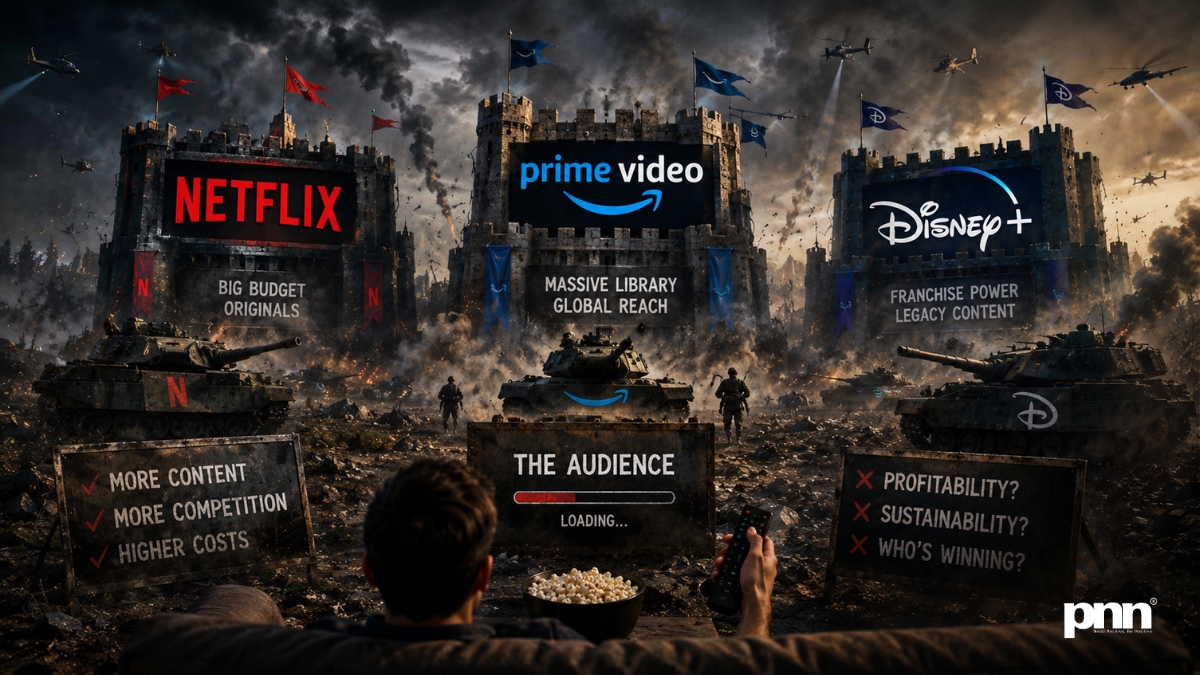
Profitability Challenges
- High production costs
- Fluctuating subscriber growth
- Increasing competition
Content Saturation
- Too many releases are competing for attention
- Shorter content lifecycles
- Reduced long-term impact
Audience Fatigue
- Decision paralysis
- Decreased engagement with individual titles
Because when everything is available, nothing feels essential.
The Strategy Behind The Madness
Streaming platforms aren’t just producing content.
They’re engineering engagement.
- Algorithms recommend personalized viewing
- Release schedules are strategically timed
- Content is designed for binge consumption
It’s not just entertainment.
It’s a retention strategy.
The Sarcasm (Because It’s Earned)
There’s something almost admirable about the persistence.
Spend billions. Release everything. Hope something sticks.
Because clearly, the solution to too much content is… more content.
Brilliant.
The Franchise Obsession
One noticeable trend is the reliance on established universes.
- Spin-offs
- Sequels
- Expanded storylines
Why?
Because familiarity reduces risk.
Originality is appreciated.
Predictability is profitable.
Or at least, it’s supposed to be.
The Global Expansion Factor
Streaming isn’t limited by geography.
- Platforms are investing heavily in international content
- Regional productions are gaining global audiences
- Localization strategies are becoming essential
This creates:
- New opportunities for creators
- Broader audience engagement
- Increased cultural exchange
But also:
- Higher operational complexity
- Greater financial pressure
The Innovation Trade-Off
Every strategic decision comes with consequences.
Pros:
- Unprecedented content availability
- Opportunities for diverse storytelling
- Technological advancements in distribution
Cons:
- Unsustainable spending models
- Reduced content longevity
- Increasing reliance on data-driven decisions
It’s not a collapse.
It’s a balancing act.
The Bigger Pattern: Attention As Currency
In the streaming ecosystem, attention is everything.
- Subscriber retention drives revenue
- Engagement metrics influence production
- Visibility determines success
Which means content isn’t just created.
It’s calculated.
The Industry Reality: Winning The Audience, Losing The Margin?
Here’s the paradox:
- Platforms are winning viewership
- Content quality is improving
- Global reach is expanding
And yet:
- Profit margins remain uncertain
- Costs continue to rise
- Competition intensifies
It’s a rare scenario where success doesn’t immediately translate into profitability.
The Future: Consolidation Or Reinvention?
Looking ahead, a few possibilities emerge:
- Platforms may reduce content volume
- Subscription models could evolve
- Consolidation between services may increase
Because eventually, even the most ambitious strategies encounter reality.
And reality tends to ask inconvenient questions.
The Final Thought: When Entertainment Becomes Endless
Streaming has transformed how stories are told, distributed, and consumed.
It has:
- Democratized access
- Expanded creative possibilities
- Redefined audience expectations
But it has also introduced a new challenge.
Sustainability.
Because in a world where content is infinite, attention is finite.
And profitability?
Still… under negotiation.
